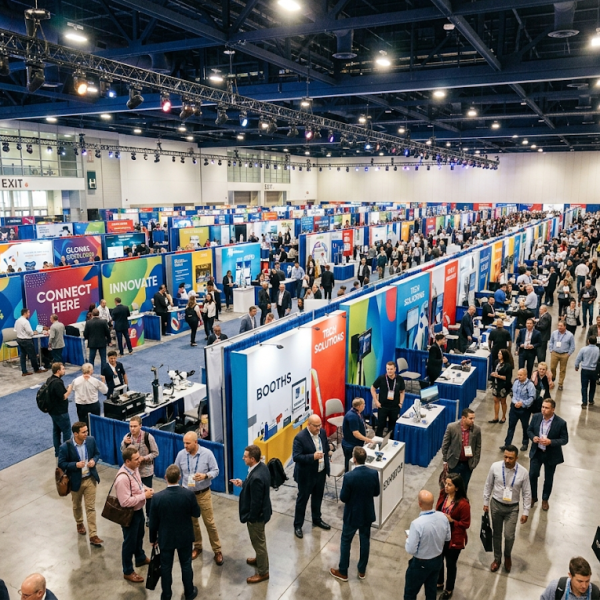
Las Vegas has long positioned itself as the convention capital of the world, hosting hundreds of trade shows, conferences, and corporate events every year that draw attendees from every continent. What has changed in recent years is not the scale of these events but the composition of the audience attending them. Exhibitor floors that were once dominated by domestic buyers now regularly include delegations from Asia, Europe, and Latin America, and organizers are discovering that their old approach to language support no longer keeps up.
The Old Model Was Never Built for This Scale
For years, the standard approach to multilingual support at a Las Vegas trade show meant booking a handful of on-site interpreters and translating a printed program into two or three languages ahead of time. That worked reasonably well when the international attendee share was small and predictable. It breaks down quickly once a show attracts delegations speaking a dozen or more languages, each expecting signage, session materials, exhibitor directories, and follow-up communications in their own language, not just spoken interpretation during keynote sessions.
The result, for organizers who have not modernized their process, is a familiar scramble in the weeks before a major show: rush translation orders, inconsistent terminology across different vendor-produced materials, and a printed program that is already out of date by the time it reaches attendees because last-minute schedule changes never made it into every language version.
Centralizing the Workflow Changes the Equation
Show organizers who have solved this problem tend to share one thing in common: they no longer treat translation as a series of one-off vendor orders. Instead, they rely on a coordinated workflow, often built around an ai powered translation management system, that keeps every language version of event materials synchronized from a single source. When a session time changes or a speaker drops out, the update propagates to every translated version automatically rather than requiring someone to manually notify five different freelance translators.
This kind of centralized system also solves a subtler problem: terminology consistency. A recurring sponsor name, a technical product category, or a venue-specific term needs to read the same way across the program guide, the mobile app, and the signage. Without a shared terminology database, different translators working in isolation will inevitably produce slightly different versions of the same term, which reads as unprofessional to attendees who notice the inconsistency.
Where Formal Certification Still Matters
Not every document at a convention is casual marketing copy. Exhibitor contracts, liability waivers, and international business agreements signed on the show floor often require the added rigor of professional certified translation services, particularly when the documents need to hold up to legal or regulatory scrutiny back in the attendee's home country.
Convention organisers make a surprising number of decisions about refreshment, and they are not trivial. An international audience arrives with different expectations about what should be available between sessions. The tea vs coffee balance at a break is a small but genuine part of how comfortable delegates feel.
Las Vegas convention organisers are rethinking multilingual support because delegate lists have shifted faster than their service contracts. Competing conference cities have already adapted, treating the evening programme as part of the offer rather than an afterthought. Venues built around rooftop dining dubai are pitched directly at that market, where the view now does the work a hospitality suite used to.
Given the volume of German-speaking exhibitors and attendees who travel to Las Vegas for major industry shows, many organizers also maintain a relationship with specialized german translation services to ensure that technical product documentation and contractual language hold up to the same standard as the English original.
What the Events Industry Is Watching
Trade publications covering the meetings and events industry have taken notice of this shift. Organizations that track convention attendance trends have repeatedly flagged the growing share of international delegates at major Las Vegas shows as a structural change rather than a temporary spike, which means the language infrastructure question is not going away.
For organizers planning next year's show floor, the practical lesson is straightforward: the days of treating translation as a last-minute add-on are ending. Building a coordinated, centralized language workflow into event planning from the start is quickly becoming the difference between a smooth international show and a scramble that attendees notice.